
Under-eye patches go on with the wider, rounded end toward the outer corner of the eye and the narrower end toward the nose, on clean dry skin, just below the lash line — and they come off after 15 to 20 minutes, before they dry. Most of what goes wrong with eye patches is one of those three things done the other way round. This is the full how-to, from the box to the pat-in afterwards, written by a factory that makes them.
 Sample image
Which way up do eye patches go?
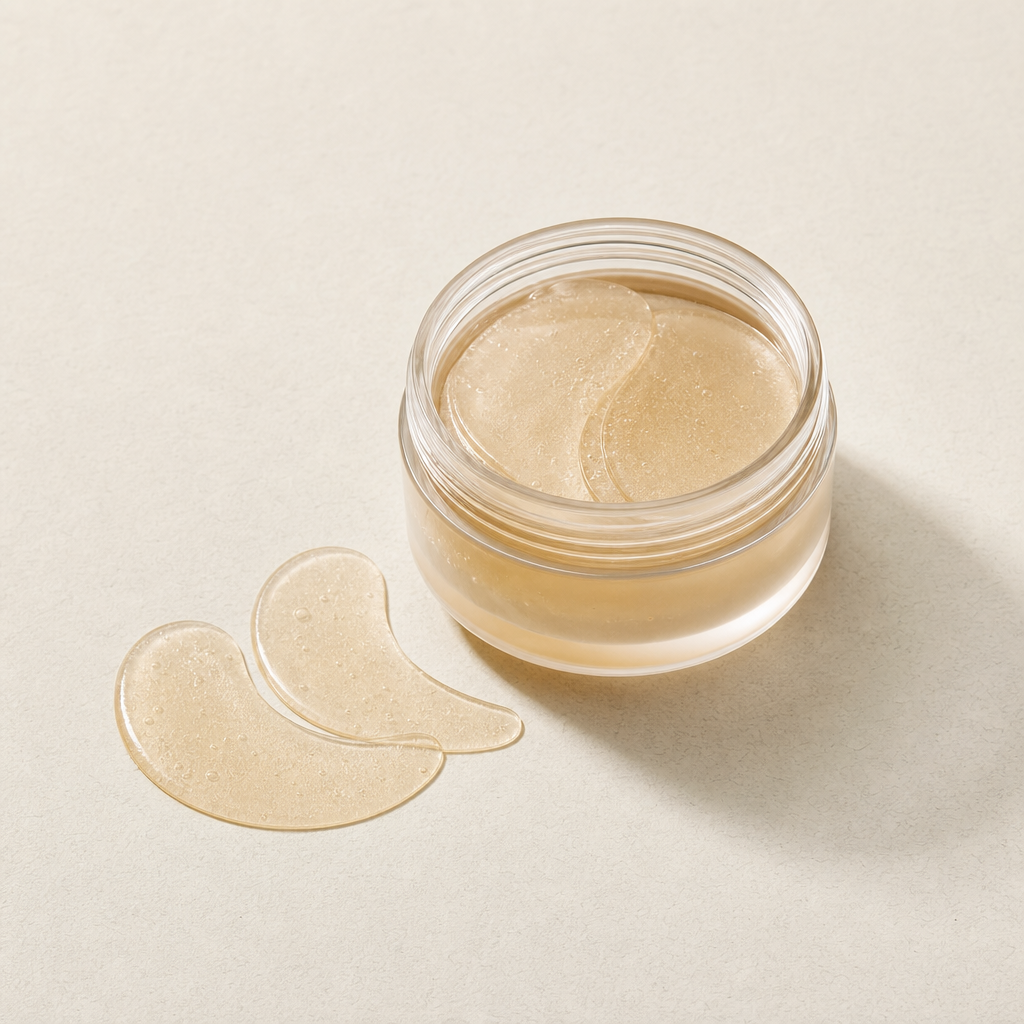
Most under-eye patches are a crescent or teardrop. The wide, rounded end sits toward the outer corner of the eye; the narrow tapered end points toward the nose. The curved top edge follows the lower lash line, sitting a few millimetres below the lashes rather than on them. If the pair looks mirrored in the tray, that is the point — one is cut for the left eye and one for the right.
Put on the other way round, the patch bunches at the inner corner, leaves the outer under-eye uncovered, and lifts as soon as you blink. If a patch keeps sliding, orientation is the first thing to check.
The gel side. On a hydrogel patch the gel is the soft, slightly tacky, cool surface; the smooth film on the other side is the carrier and peels away or stays on the outside. If the pouch contains a clear plastic backing sheet, the patch is stuck to it gel-side down — lift the patch off the sheet, not the sheet off the patch.
How to apply eye patches so they stay put
- Start with clean, dry skin. Cleanse, then pat the under-eye area dry. A patch will not seal over oil, sunscreen or a wet surface — hydration is trapped under the seal, so the seal has to form first.
- Lift the patch from the tray by the narrow end. Use the small spatula if the jar has one, or clean fingertips. Hydrogel tears if it is pinched hard, so lift rather than pull.
- Place the narrow end first, at the inner corner beside the nose, then lay the patch outward along the lash line. Keep it a few millimetres below the lashes so it does not catch when you blink.
- Press gently from the centre outward for a few seconds so the whole surface makes contact. Contact is what does the work; a patch that is only touching at the edges is barely working.
- Stay relatively still. Sitting or lying back keeps the seal intact. Talking, laughing and walking around are the usual reasons a patch slides.
- Take it off before it dries — 15 to 20 minutes for hydrogel — then pat the leftover essence in rather than rinsing it away.
Applying them before the rest of your routine is the useful order: a patch seals whatever is under it, so it goes on bare, hydrated skin, and serum and moisturiser follow after it comes off. Makeup goes on last, after the residue has absorbed.
How long to leave eye patches on: the short answer
Hydrogel patches: 15–20 minutes.
Bio-cellulose: 20–30 minutes — it holds water longer and clings harder.
Cotton or non-woven sheet patches: 10–15 minutes — thin fabric dries fastest.
Overnight patches are a different product entirely (adhesive or microdart), not a wet gel, and are designed to stay on.
The number is not a ritual. It is the length of time the patch is still doing the thing you bought it for.
What is happening during those twenty minutes
A hydrogel patch is roughly 60–90% water held in a gel network. Pressed against skin, it does two things at once:
- It occludes. A sealed layer over the skin stops water evaporating from the surface, so moisture accumulates in the upper layers underneath. This is the larger effect, and it is the same principle behind any occlusive product.
- It donates. The gel gives up some of its own water and dissolved ingredients into that softened surface.
Both of those run strongest early and taper. By around the twenty-minute mark on a typical patch, most of what was going to transfer has transferred.
What goes wrong if you leave it on longer
The gel does not simply stop. Once it has given up enough of its water, the gradient reverses — the drying sheet begins drawing moisture back out of the skin it was just hydrating, and continues evaporating from its own exposed surface.
You can feel the point it happens. A working patch is cool and heavy. A finished one feels warm, looks thinner, and starts lifting at the edges. That is the signal to take it off, and it is more reliable than a timer.
Never let a wet patch dry out on your face. It is the single most common mistake with this format, and it undoes part of what the patch just did. The instruction exists for a real reason, not to make you buy more.
Why not shorter?
Under about ten minutes the occlusive effect has not had time to build. You will get the cooling, which is immediate, but not much of the hydration — and the cooling is the part that feels like it is working while the hydration is the part that is.
If you are short of time, ten minutes is worth doing. Two minutes is decoration.
What to do after you take them off
Pat the residue in; it is the same essence the patch carried. Do not rinse unless the product tells you to. Follow with your usual eye cream or moisturiser if you want the hydration to last — the patch puts water in, something occlusive afterwards keeps it there. Then makeup, if any. Used patches are single-use and go in the bin, not back in the jar.
Common questions this raises
Can you leave them on overnight?
Not a wet gel patch. It will dry, reverse, and fall off somewhere in the bed. Products designed for overnight use are built differently — an adhesive patch or a dissolving microdart array, with no free water to lose.
Can you reuse one?
No, on two counts. It has already given up most of what it carried, so there is little left to deliver. And it has been in contact with skin and then air, in a product with a water activity close to 0.99 — which is a comfortable environment for microbial growth. Single use is a hygiene requirement, not an upsell.
Does refrigerating change the time?
No, only the sensation. A chilled patch feels considerably better and may briefly reduce the look of puffiness through vasoconstriction, but the hydration timing is unchanged. It is a genuine free upgrade and worth doing.
Should you rub in what is left on the skin?
Yes. The residue is the same essence the patch was carrying. Patting it in is not a trick to seem thorough — it is product you already paid for.
 Inside our factory
Why brands specify different times
Wear time is not a marketing choice; it falls out of three decisions made at the formulation stage:
- Thickness — a thicker sheet carries more water and stays active longer
- Water content — more water means more to give, and a stronger cooling hit
- Essence charge in the pouch — free liquid around the sheet extends the wet phase
So a patch that says 30 minutes is usually genuinely thicker than one that says 15. It is one of the few numbers on a box that reflects something real about the product.
Times given here are typical for the formats described and are general guidance, not a substitute for the instructions on a specific product. Hydration and appearance effects described are cosmetic; these products are not intended to treat any condition.
Developing a hydrogel product?
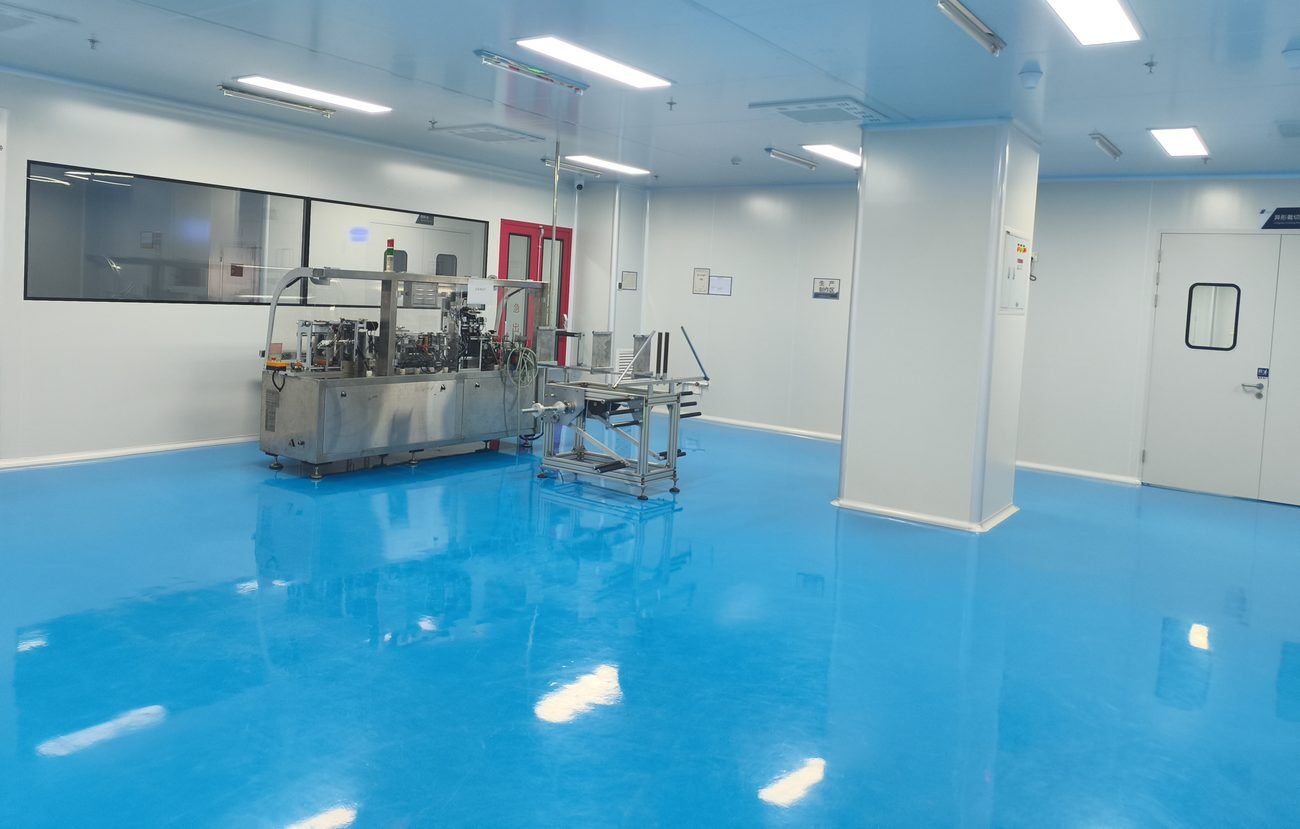
Yanse manufactures hydrogel eye patches, face masks and lip masks at our own ISO 22716 plant in Fujian — 8,000 m², Class-100,000 cleanroom, 11 QC checkpoints, audited on-site by L'Oréal, Watsons, MINISO and Mentholatum. Our hydrogel line is a three-head system, so two or three formulations can be laid down side by side in a single sheet. Plant-based gel system: halal and vegan compatible as standard.
Request samples & specifications →Three-zone capability · plant-based gel · halal & vegan compatible · 24-hour reply · NNN before any formulation work
Educational content for brand and product teams. Ingredient and claim information is general and varies by market regulation; finished-product claims should be confirmed against the rules of your target market. Yanse Cosmetics is a contract manufacturer (OEM/ODM) and does not sell finished consumer goods under its own brand. Trademarks referenced belong to their respective owners; no comparison or equivalence claim is made.